 Zoo Framework
Overview
Core components
| Component | Role |
|---|---|
BaseWorker | Task execution unit; you implement _execute() |
Master | Lifecycle entry point: load config, register Workers, run, shut down |
core/waiter/ | The scheduler; worker:mode picks the execution model |
ScopedContainer | Scoped container (process / session / prototype) that never replaces the class |
EventNode / EventChannel | In-process event pipeline |
EventFIFO | One independent queue per channel |
StateMachineManager | Read/write state by scope + key path, with persistence |
On naming: the project name and some legacy identifiers use a zoo metaphor (
Worker/Master/Cage/Event). The metaphor affects naming only, not semantics — the table above uses functional names.
Quick start
pip install zoo-frameworkfrom zoo_framework.core import Master
from zoo_framework.workers import BaseWorker
class Inspector(BaseWorker):
def __init__(self):
super().__init__({"name": "inspector", "is_loop": True, "delay_time": 2})
def _execute(self):
print("patrol")
master = Master()
master.register_worker("Inspector", Inspector)
master.run()is_loop is a read-only property backed by _props as the single source of truth; delay_time is the idle seconds after each run. Registration goes through Master.register_worker — the deprecated @worker decorator writes a legacy registry that Master never reads.
Events and reactors
from zoo_framework.core import event

@event("change_test_number")
def on_change_test_number(data):
    print(f"number changed: {data}")
@event(topic, channel="default") wraps the function into an event reactor bound to the channel at import time. Producers build an EventNode and push it through EventProvider().push(...), the EventWorker drains all channels.
Performance baseline
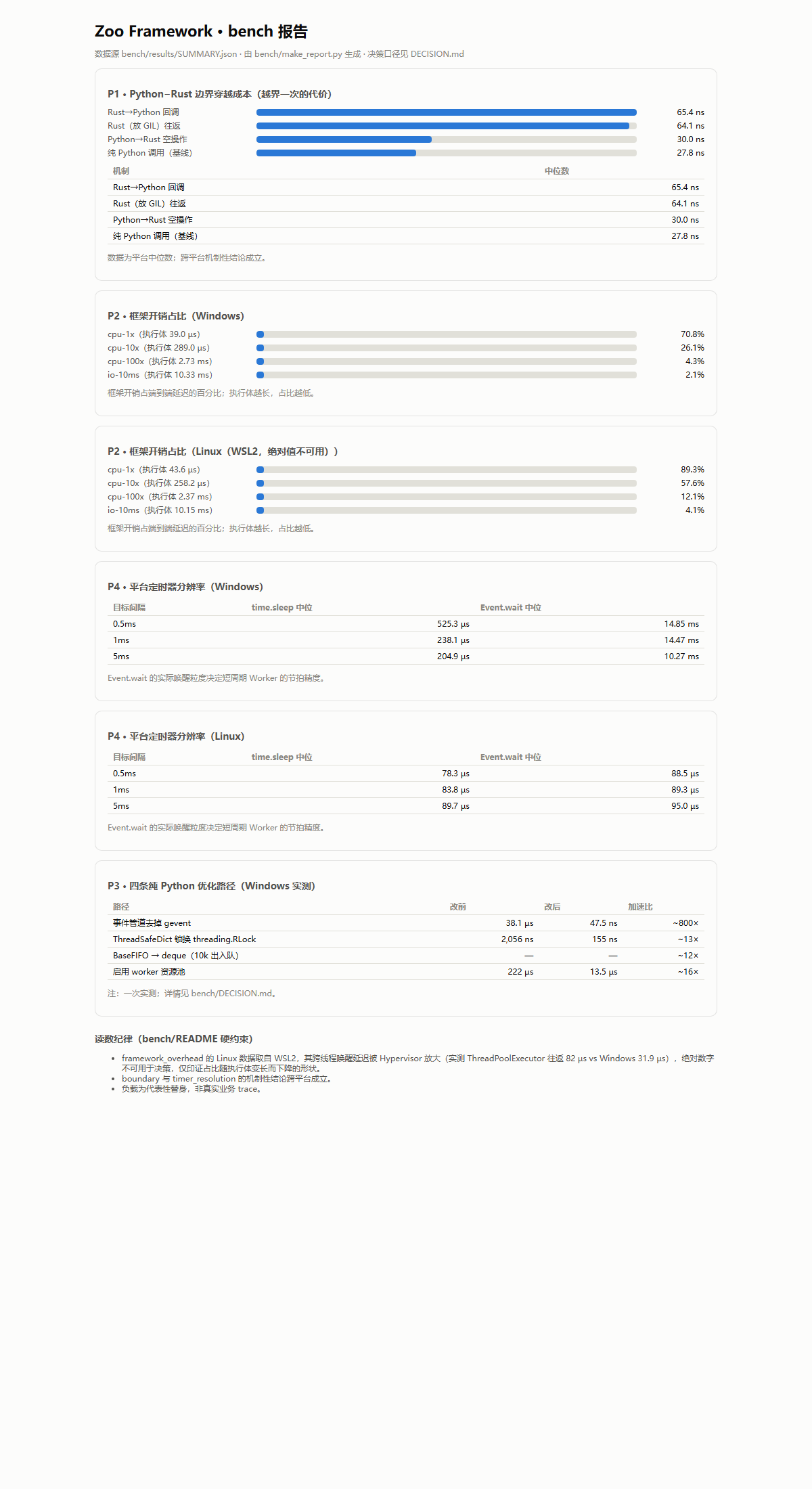
From bench/ (Rust feasibility PoC plus pure-Python optimization measurements; data and decision rationale in bench/DECISION.md):
- Framework overhead as a share of end-to-end latency drops quickly as the task body grows (cpu-1x 70.8% → cpu-100x 4.3%, Windows measurement).
- Four pure-Python optimization paths measured 12×–800× speedups (dropping gevent from the event pipeline, the
ThreadSafeDictlock, FIFO→deque, enabling the worker pool by default). - A Rust scheduler is a no-go: GIL-bound, measured at most 1.67× — far less than the pure-Python items.
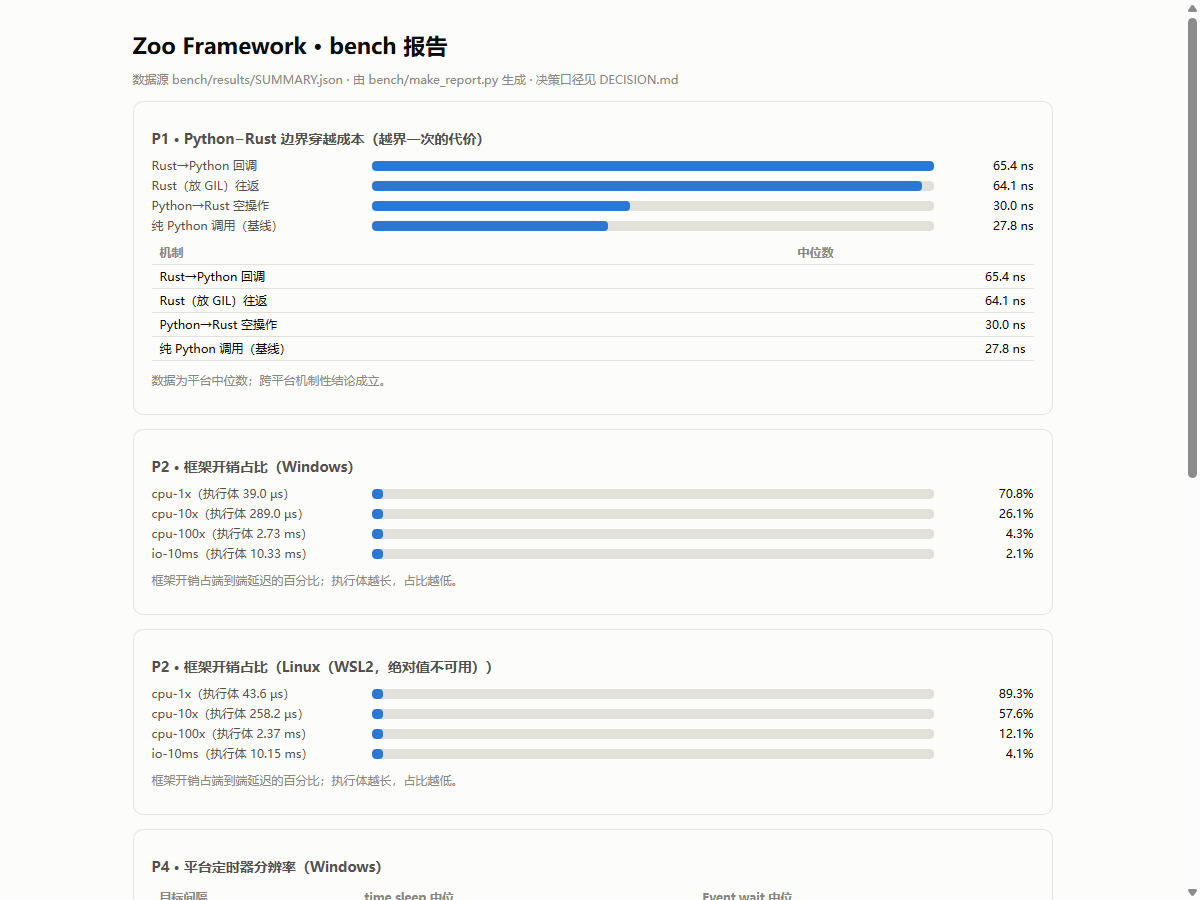
Full report: full-page bench screenshot.